
A few weeks back, I came across this story of an octopus, and it has been on my mind since then. Some of y’all must have probably read about it. But for those who haven’t, this story is going to blow your mind.
A group of scientists from Monterey Bay Aquarium Research Institute (MBARI), California, were researching marine life. In the summer of 2007, the team had a little extra time in hand and thought of taking a deviation from their project and exploring the seafloor of Monterey Canyon using a robotic device.
(Why do best moments in science happen serendipitously?)
The team spotted a female octopus belonging to the species Graneledone boreopacific approaching a rock, which later settled on the rock. Upon closer observation, they noticed that she was sitting over a clutch of eggs and was brooding (a process where the female animal sits over her eggs till they hatch).
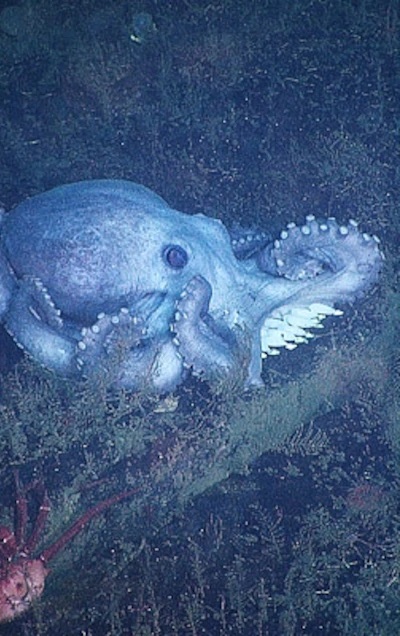
It is common knowledge that a female octopus lays eggs only once in her lifetime. The mother octopus then rests atop the eggs, protecting them from any predators as well as providing them warmth and cleaning the water around till the eggs develop and hatch. Sounds like a lot of work? Doesn’t it? To make it more difficult, the mother octopus is starving during this period and does not move away from her eggs even for a moment, not even to feed herself. Once the eggs are hatched, the mother octopus dies, probably because of starvation. Typically, this brooding period is short, mostly ranging from 2-6 months, varying a bit depending on the species of octopuses. However, the data we had till then was only from studying shallow-water octopuses, with little or no knowledge about deep-sea octopuses.
Coming back to our story.
The team of researchers continued to visit the octopus at different intervals of times. She was there every time. Alert. Watchful for any predators. Months passed. And every time the team saw her on that rock, they thought that was the last time she was going to be there. BUT.
2 months. Still there.
6 months. Still there.
12 months. Still there.
The previous record for the octopus brooding period was of 14 months in Bathypolypus arcticus, which is another deep-sea octopus species. So they expected that this one would also be similar. BUT.
18 months. Still there.
2 years. Still there. The team nicknamed her ‘Octo-mom’.
Every time they scanned the eggs using a laser, they observed that the babies were growing steadily. Formerly purple-ish in color, the mother octopus had now become completely pale and appeared white in color because of starvation. Her eyes had become cloudy. She did not eat the crab meat offered by the team either. She was visibly becoming weaker with every visit. And yet, every time a predator tried to get nearby, she successfully tackled them. She had approximately 161 eggs to protect.
3 years. Still there. I would call her ‘Octo-super-mom’.
4 years. Still there.
September 2011 was the last time she was spotted there, 53 months after her first sight. This is the longest known brooding period for any animal on this planet. When the team tried to look for her in October 2011, she was gone. The place she was guarding for the past 4 and half years, (let me repeat, 4 and half years) had empty egg sacs there. The team also captured a few baby octopuses of the same species around that rock.
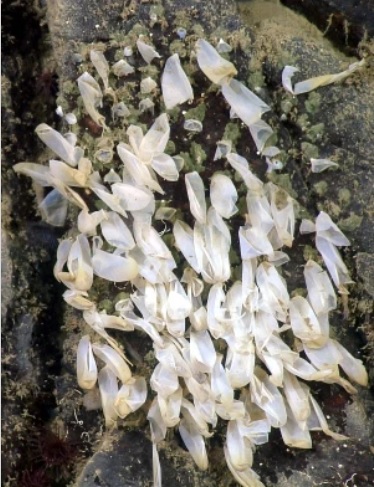
When I read this story, I was obviously taken aback and had a lot of questions in my head. One that most of y’all will be thinking, and is also at the top of my list is why would evolution support such a long brooding period? 53 months? Albeit, deep-sea life is still mysterious for the most part of it; because it is expensive and time-consuming to reach these depths, there is a dearth of knowledge about the survival mechanisms and conditions down there. The environment is really harsh and there is no ray of light. Literally. So, to survive in such extremely cold temperatures, maybe that long a period is needed to fully prepare the babies to fight the world outside and increase their chance of survival.
When I saw the picture of Octo-mom, I wanted to know what kept her going through such harsh conditions. Starving herself for 53 months, yet, alert enough to keep protecting her eggs. Such resilience. Was there any moment when she felt tempted to leave for just a bit and feed herself? Did she know that she was going to die in the process of saving her babies? I guess it is in the nature of every mother in this universe to do whatever it takes to protect her babies. Whatever it takes.
I am very pleasantly shocked and amused by this story at the same time. How little do we know about the nature of this universe, and yet, live our lives arrogantly behaving like we know everything.
Footnote: The original research paper.
-Sanketa Raut
 Samay and Solace