
How long can a women carry a baby inside her womb?
9 months? That’s the normal we’re used to. But what if I tell you, it can be 10 years? Or say 30 years?
Sounds crazy, right? Stay with me!
I recently heard about a case where a 73-year-old woman went to the hospital with complains of abdominal pain. Upon further testing, it was found out that she was carrying a baby inside her abdomen since past 30 years. The woman had no idea of its existence.
Of course, the baby wasn’t alive; it was a stone baby.
Scientifically, this condition is called as a lithopaedion; lithos meaning stone and paedion meaning child.
It is an extremely rare phenomenon, occurring in less than 1 percent of pregnancy; with about less than 500 cases ever reported in the history of medical literature. In normal pregnancy, the baby grows inside the uterus, what we call as mother’s womb. This ensures proper nourishment of the baby. Lithopaedion occurs in cases of ectopic pregnancy, that is when the fetus implants and grows outside the uterus, in places like abdominal cavity.
Due to lack of nourishment, the baby dies and the naturally terminated fetus isn’t expelled out, but rather remains inside the body. The dead tissue starts to degenerate posing a risk of infection inside the mother’s body. As a defense mechanism, the mother’s body calcifies the baby, that is it deposits calcium in and around the baby turning it into a stone baby.

When this happens, the stone baby goes unnoticed for years. It does not present with any observable symptoms, except abdominal pain. In some cases, women have carried a stone baby for as long as fifty years.
The earliest reported case of a stone baby dates back to 1582. A lady named Madame Colombe Chatri, living in French town, Sens, was pregnant and went into labor pain before the birth was due. The midwives who were taking care of her claimed that she passed a lot of amniotic fluid and blood; however, there was no childbirth. Madame Chatri fell quite unwell and remained in bed for almost three years. She complained of persistent abdominal pain and felt a hard mass of tumor inside her.
She soon had turned into the gossip of the town and there were speculations that she still carried the baby inside her, which would kill her one day. After she passed away twenty-eight years later, her husband requested that her body be dissected. When the surgeons cut open through the stomach, they saw a huge growth which was hard and brittle, looking like a shell. Only after breaking a considerable portion of the covering, they realized what was inside it.
A calcified baby.
Physician, Jean d’Ailleboust, who was among many doctors who saw the lithopaedion was surprised and shocked at the same time. Never had they seen or read anything like this before. The news spread throughout the town, and many townsmen had come to see the prodigy.
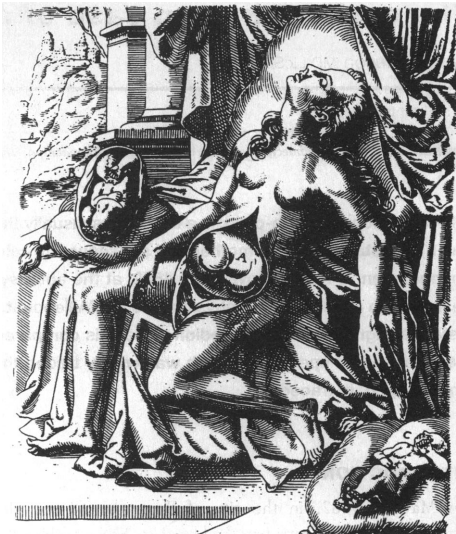
As described by Jean d’Ailleboust in is thesis later, the lithopaedion was roughly the size of the rounded shell surrounding it. The knees were bent, and the legs drawn up towards the chest. The feet and lower legs were fused with the calcified deposits. It could clearly be seen that the fetus was of female sex.
The following picture named ‘The lithopaedion of Sens’ is the depiction from the original thesis of Jean d’Ailleboust. (Image taken from a research paper).
Medicine has advanced a lot from then till now. Majority of ectopic pregnancy cases are diagnosed, terminated, and the fetus is removed out because such cases do not lead to a successful pregnancy. Concomitantly, lithopaedions are also rare nowadays due to improved access to prenatal consultations leading to early diagnosis and treatment. In the past century, some cases have been reported in India in the states of Tamil Nadu (1962), West Bengal (1977), Maharashtra (1978), and Orissa (1999).
What this story leaves me with is a huge sense of admiration towards the fact that our body can adapt to so many different situations. And how we can be completely oblivious to what is going on inside us.
-Sanketa Raut
 Samay and Solace