
What if I tell you that a crab has been saving all of our lives since decades?
Meet the horseshoe crab.
This animal is often referred as the ‘living fossil’ and is among the oldest creatures on the Earth. It is a primitive animal with exceptionally effective adaptions and has barely changed since it first appeared 450 million years ago. That’s right. 450 million years ago! Which means this animal has survived Ice Ages and even mass extinctions that killed all the dinosaurs.
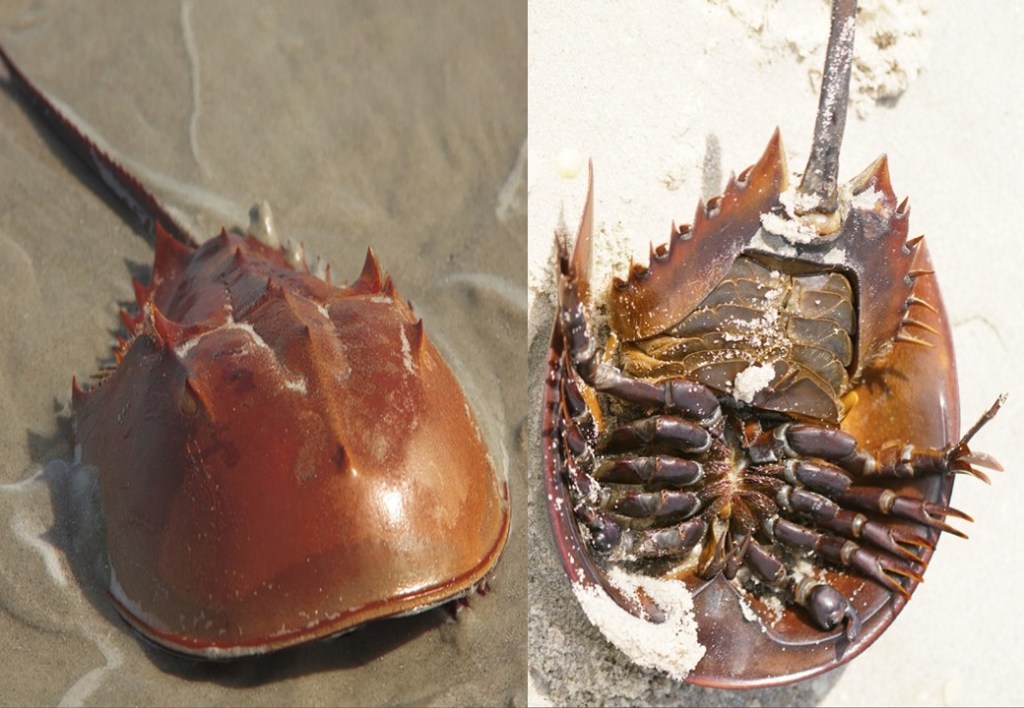
The blood of the horseshoe crab is sky blue in color and is one of the most expensive liquids on planet Earth, costing about $60,000 a gallon.
But the bigger question is who is buying horseshoe crab blood? And why?
This blood is bought by several bio-medical and pharmaceutical companies to save YOU, to save ME, and to save ALL OF US. Every vaccine, injectable drug, medical devices, or anything that go inside our body needs to be absolutely sterile, that is it should be free from bacteria or micro-organisms, for being approved for use. Because a tiny amount of bacterial toxin or contaminant present, can kill you if injected directly into the body.
That is where the horseshoe crab comes into the picture. Its blood contains a special clotting agent which is used to make a concoction called LAL (Limulus Amoebocyte Lysate). The LAL is capable of detecting bacterial toxin even in minute concentrations. Horseshoe crab blood is the only natural source to make LAL and all the pharmaceutical companies around the world rely on this crab blood.
Every year, in the month of May, these crabs come to the shore for spawning (laying eggs). That’s when the medical industry catches the crabs and takes it to the laboratory. The crabs are then drained of 30% of their blood from a vein near the heart. After which, the crabs are returned back to the water.

LAL has been in commercial use since 1970s. Before the discovery of LAL, scientist used to inject vaccines into rabbits and check for allergic reaction or any symptoms such as fever to show up, which was indicative of contamination in the vaccine. This led to lots of rabbits being sacrificed for testing, and yet was not a 100% confirmatory test.
LAL revolutionized this method, saving rabbits; but at the risk of their own extinction. Till early 1990s, this process of extracting blood from the crab seemed sustainable. The laboratories claimed that the death in the bled crab was only 3%. Population surveys showed that the crabs were plentiful, and conservationists didn’t place much value on the species.
However, by early 2000s, the picture began to shift. The death rate which was initially predicted to be 3%, was estimated to be around 30%. Horseshoe crab numbers declined from 1.24 million in 1990 to less than 334,000 in 2002 (Delaware Bay survey, home to the largest population of horseshoe crab in the US).
It has been five decades, do we not have any substitute for this crab blood?
Recombinant Factor C (rFC), first discovered in 2003, was proposed as a substitute for horseshoe crab blood. However, the results obtained from rFC testing were contradictory and its efficacy remained majorly questionable for many years. Recently, the growing concern regarding the crab population has led scientists all over the world to focus on synthetic alternative, and a plethora of research is underway for the same.
Four years ago, in 2018, FDA (Food and Drug Administration) approved the first drug that used rFC for toxin testing giving a ray of hope to save the horseshoe crabs.
Unfortunately, as of now, LAL still remains as the gold standard. As recent as COVID-19 vaccine, was also tested for bacterial toxin using horseshoe crab blood.
What amuses and saddens me at the same time is that this creature is so perfectly adapted that it has survived for millions of years. It has won over the nature. The crab that has survived mass extinction that ended dinosaurs, are we as humans, going to be the cause of its extinction?
-Sanketa Raut
 Samay and Solace